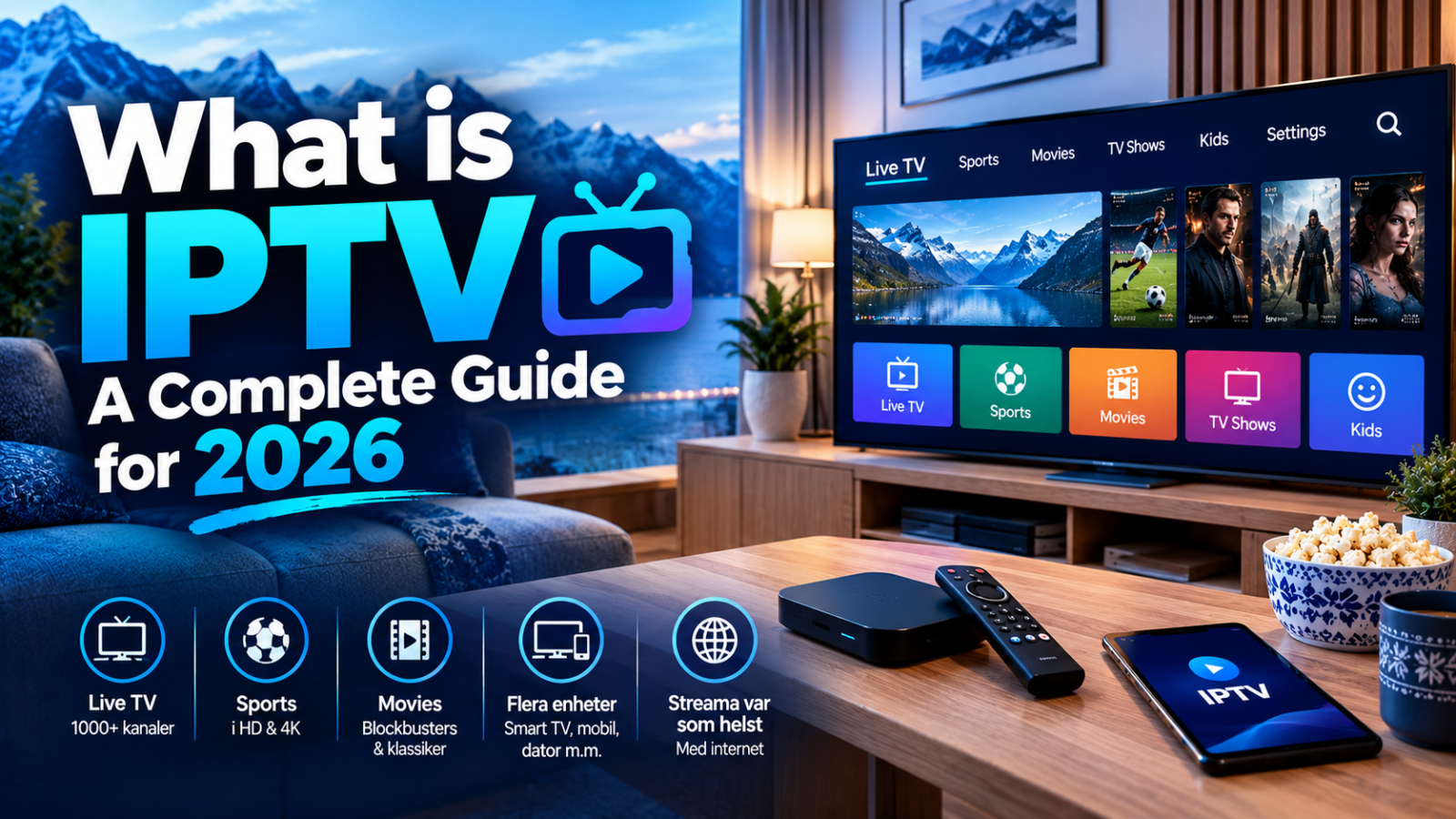
What Is IPTV? A Complete Guide for 2026
What Is IPTV?
IPTV stands for Internet Protocol Television. It’s a technology that delivers television content over the internet instead of through traditional cable, satellite, or terrestrial broadcasts.
Think of it this way: traditional TV is like a radio broadcast — everyone receives the same signal at the same time. IPTV is more like YouTube or Netflix — content is delivered directly to you through your internet connection, on demand, whenever you want it.
With IPTV, you can watch live TV channels, catch-up programs, movies, and series on virtually any device — Smart TV, smartphone, tablet, computer, or streaming box.
How Does IPTV Work?
IPTV works by sending television content through your internet connection in small data packets. Here’s the simple process:
You select a channel or program — your device sends a request through your internet connection
The server verifies your access — it checks that your subscription is active
The stream begins — content is delivered to your device in real-time
Your device decodes the data — it converts the packets into audio and video on your screen
Unlike traditional broadcasting, IPTV uses two-way communication. This allows for interactive features like pause, rewind, fast-forward, and recording live TV.
The Three Types of IPTV
| Type | What It Is | Examples |
|---|---|---|
| Live IPTV | Real-time TV channels streamed over the internet | Live sports, news, TV channels |
| Video on Demand (VOD) | A library of movies and shows you can watch anytime | Netflix, HBO Max, Disney+ |
| Time-Shifted IPTV | Catch-up TV and recording features | Program replay, DVR functionality |
IPTV vs Traditional TV: What’s the Difference?
| Feature | Traditional Cable/Satellite | IPTV |
|---|---|---|
| Delivery | Coaxial cable or satellite dish | Internet connection |
| Channel selection | Limited packages (300-500 channels) | Thousands of channels |
| Cost | €60-100+ per month | Often significantly less |
| Contract | 12-24 month binding | Usually month-to-month |
| Hardware | Provider box (rental) | Works on your own devices |
| Where you can watch | Locked to your home | Anywhere with internet |
| Catch-up / VOD | Rarely included | Often included |
| Installation | Technician visit required | Self-installation |
Why Is IPTV Growing So Fast?
Several factors are driving the rapid adoption of IPTV worldwide:
💰 Significant Cost Savings
Traditional cable packages cost €60-100+ per month. IPTV services typically cost €10-30 per month for comparable or better content.
📺 Massive Channel Selection
IPTV offers thousands of channels from around the world — far more than most cable providers offer locally.
📱 Multi-Device Flexibility
IPTV works on Smart TVs, smartphones, tablets, computers, and streaming devices. You’re not locked to a single TV in your living room.
⏪ Catch-Up and On-Demand
Most IPTV services include catch-up features (watch programs you missed) and VOD libraries with thousands of movies and series.
🌍 Access Anywhere
Watch your favorite channels while traveling, at your summer house, or living abroad. All you need is a stable internet connection.
🏔️ High-Speed Internet Is Everywhere
With fiber and high-speed broadband now available in most urban areas, buffering-free streaming is a reality for most households.
What Do You Need for IPTV?
Getting started with IPTV requires just four things:
1. A Stable Internet Connection
HD streaming: Minimum 10-15 Mbps
4K streaming: Minimum 25-50 Mbps
2. A Compatible Device
Smart TV (Samsung Tizen, LG webOS, Android TV)
Amazon Fire TV Stick
Android TV box
Smartphone or tablet
Computer (Windows or Mac)
3. An IPTV App
Popular IPTV apps include:
IPTV Smarters Pro
TiviMate
IBO Player
GSE Smart IPTV
4. An IPTV Subscription
From a provider who gives you either:
Xtream Codes API (username + password + server URL)
M3U URL (a link to your channel list)
Is IPTV Legal?
This is the most common question, and the answer is: the technology itself is 100% legal.
Your own internet provider (like Telia, Telenor, or Allente) uses IPTV to deliver its TV packages. Netflix, YouTube, and Viaplay all use the same technology.
The Critical Distinction
| Type | What It Means |
|---|---|
| Legitimate IPTV | The provider has licensing agreements with content rights holders. Examples: Telia Play, Allente, Viaplay |
| Illegal IPTV | The service streams content without permission from rights holders |
How to choose wisely: Select a provider that is transparent about its content licensing, offers secure payment methods, and has verifiable customer support.
Common IPTV Myths Debunked
Myth: IPTV is complicated to set up
Reality: If you can use Netflix, you can use IPTV. Most people are watching within 10 minutes of getting a subscription.
Myth: IPTV always buffers
Reality: Buffering is usually caused by insufficient internet speed, WiFi interference, or overloaded servers. With a stable connection and a reliable provider, IPTV streams smoothly.
Myth: IPTV is only for tech-savvy people
Reality: Modern IPTV apps are designed for everyone. The interfaces are user-friendly and work with standard TV remotes.
Myth: IPTV doesn’t work with Smart TVs
Reality: Most Samsung and LG Smart TVs have IPTV apps available directly in their app stores.
How to Get Started with IPTV
Step 1: Choose a Reliable Provider
Look for:
Free trial or money-back guarantee
Stable servers with good uptime
Responsive customer support
Positive user reviews
Transparent pricing
Step 2: Check Your Internet Speed
Run a speed test at fast.com. You need at least 10-15 Mbps for HD and 25-50 Mbps for 4K.
Step 3: Install an IPTV App
Download a compatible app for your device from the official app store or the provider’s recommended source.
Step 4: Log In and Start Watching
Enter your Xtream Codes credentials or M3U URL in the app. Wait for the channel list to load, and you’re ready to watch.
Frequently Asked Questions
1. What does IPTV stand for?
IPTV stands for Internet Protocol Television — television delivered over the internet instead of through traditional cable or satellite.
2. Is IPTV the same as Netflix?
Not exactly. Netflix is a Video on Demand (VOD) service. IPTV typically includes both live TV channels and on-demand content.
3. Do I need special hardware for IPTV?
No. You can use your existing Smart TV, smartphone, tablet, computer, or an affordable streaming device like Amazon Fire TV Stick.
4. How much internet speed do I need for IPTV?
For HD streaming, 10-15 Mbps is sufficient. For 4K, you need 25-50 Mbps.
5. Can I watch IPTV on multiple devices?
Yes, most IPTV services allow multiple simultaneous streams, depending on your subscription plan.
6. Is IPTV better than cable?
For many users, yes. IPTV typically offers more channels, lower costs, greater flexibility, and the ability to watch on multiple devices.
7. What’s the difference between IPTV and streaming services?
Streaming services like Netflix focus on on-demand content. IPTV includes live TV channels as well as on-demand content.
8. Can I use IPTV abroad?
Yes, most IPTV services work wherever you have a stable internet connection. Some content may be geo-restricted depending on the provider.
Key Takeaways
IPTV delivers television over the internet instead of through traditional cable or satellite
The technology is 100% legal — it’s used by major operators like Telia, Telenor, and Allente
IPTV offers significant cost savings compared to traditional cable packages
You can watch on any device — Smart TV, smartphone, tablet, computer, or streaming box
The most common IPTV types are Live IPTV, Video on Demand (VOD), and Time-Shifted IPTV
Choose a reputable provider with proper licensing, secure payment methods, and good customer support
Conclusion
IPTV represents a fundamental shift in how we watch television. By delivering content over the internet instead of through traditional broadcast systems, IPTV offers greater flexibility, more channel options, and significant cost savings.
Whether you’re a sports fan who wants every match in one package, an expat craving content from home, or just someone tired of paying for channels you never watch — IPTV offers a modern solution.
The technology is here to stay. And as internet speeds continue to improve worldwide, IPTV will only become more accessible and more popular.
This guide was updated in October 2026.